.jpeg)
Health Insurance in India: The Numbers You Should Know Before You Buy or Claim

Buying health insurance is often treated as a simple financial decision.
You compare the premium, look at the sum insured, check the list of network hospitals, and then choose a policy.
But there is a much bigger question that most policyholders ask only when they are already standing in a hospital:
“Will my insurance actually pay when I need it?”
That question cannot be answered by looking at the premium alone.
The Indian health insurance industry has grown dramatically, but so have claim disputes, grievances, medical costs and the financial consequences of inadequate coverage.
The numbers tell a story that every policyholder should understand.
A health insurance policy is not simply something you buy. It is a financial promise you need to understand before you need to use it.
India's Health Insurance Story in Numbers
According to data and analyses cited in the source material, India's health insurance industry collected more than ₹1.27 lakh crore in premiums during FY2024-25.
At the same time, approximately ₹30,000 crore worth of claims were rejected.
Grievances have also been increasing, while insurance penetration has faced pressure.
These numbers matter because they reveal an uncomfortable reality:
Having an insurance policy and being adequately protected are not necessarily the same thing.
The industry is growing.
Premium collections are increasing.
More people are technically covered.
Yet many families continue to face substantial out-of-pocket expenses when a claim arises.
Why?
Because insurance protection depends on much more than the policy's headline premium or claim settlement percentage.
1. Claim Settlement Ratio: Don't Stop at the Percentage
If you have ever compared health insurance policies, you have probably seen something like:
“Claim Settlement Ratio: 97%.”
It sounds reassuring.
But what does that 97% actually mean?

Source: IRDAI Annual Report 2024-25; Outlook Money, December 2025; Business Upturn, April 2026; Onsurity Medical Inflation Report, 2026; IBEF Insurance Sector India, 2026.
The standard calculation is:
Claim Settlement Ratio (CSR) = Claims Settled ÷ Claims Received × 100
So, if an insurer receives 100 claims and settles 97 of them, its CSR is 97%.
Simple enough.
But there is a major limitation.
CSR generally measures the number of claims, not how much money was actually paid.
Consider this example.
Suppose an insurer receives:
100 claims
90 are small claims of ₹20,000 each
10 are large claims of ₹10 lakh each
If the insurer settles most of the smaller claims but rejects or substantially reduces the larger claims, its claim settlement ratio by count can still look extremely impressive.
That is why a policyholder should not treat CSR as a complete measure of claim experience.
What CSR doesn't tell you
A high CSR does not automatically tell you:
How much of the claimed amount was actually paid.
How much was deducted.
How large claims were handled.
Why rejected claims were rejected.
Whether documentation or policy conditions created disputes.
Whether the insurer's performance is consistent year after year.
This creates an important distinction:
Claim settlement by count vs. settlement by amount
Two insurers could both report excellent claim settlement percentages by number while producing very different outcomes when measured against the rupee value of claims.
That is why the headline percentage should be treated as one data point—not the entire decision.
And CSR changes over time.
An insurer reporting a very high CSR in one financial year may report a substantially different number in another year because of changes in underwriting, claims experience, reinsurance arrangements or customer utilisation.
Always look for the latest available regulatory data rather than relying blindly on a number printed in an old brochure.
2. Incurred Claim Ratio: What Happens to the Premium Money?
Another important metric is the Incurred Claim Ratio (ICR).
The basic formula is:
ICR = Net Claims Incurred ÷ Net Earned Premium × 100
In simple terms, it tells us how much an insurer paid in claims compared with the premium it earned.
For example, an ICR of 70% broadly means that for every ₹100 of earned premium, around ₹70 went toward claims.
But this number also needs context.
A very low ratio can indicate that an insurer is paying out a relatively small portion of its premium as claims, although that can result from several factors and cannot by itself prove poor claims practices.
A very high ratio can indicate significant claims pressure and may have implications for future pricing and financial sustainability.

The source article describes broad interpretive bands around these figures, but the key point for consumers is simpler:
Don't judge an insurer using ICR alone.
Look at:
Claim settlement data
ICR
Complaint and grievance experience
Product terms
Coverage restrictions
Changes over multiple years
Insurance is too complicated for one percentage to tell the whole story.
3. Rejected Claims: The Trend Matters
One of the most important issues is not simply how many claims are rejected in a particular year.
It is the direction of the trend.
The source material, drawing on IRDAI annual reports and secondary analyses, highlights increasing claim rejection values over successive years.
For FY2024-25, the cited figures indicate approximately:
₹1.27 lakh crore in health insurance premiums
against approximately:
₹30,000 crore in rejected claims.
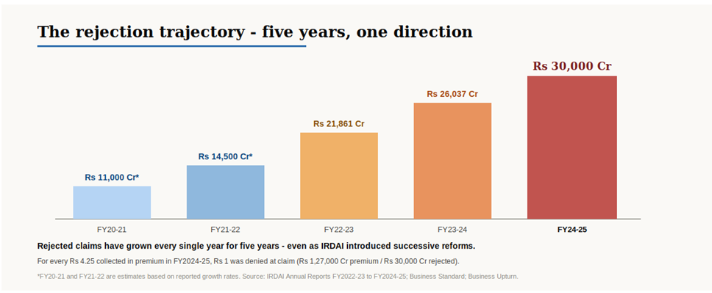
Source: IRDAI Annual Reports FY2022-23, FY2023-24, FY2024-25; Business Standard, December 27, 2024; Business Upturn, April 2026.
That works out to roughly 23.6% of the premium figure when the two values are compared.
That comparison should not be interpreted as saying that 23.6% of all claims were rejected. It is a comparison between two different measures.
But it does demonstrate the scale of money involved in disputed or rejected claims.
And this is where policyholders need to understand something important:
A rejected claim is not necessarily the end of the road.

Source: IRDAI Annual Reports FY2022-23, FY2023-24, FY2024-25; Business Standard, December 27, 2024; Business Upturn, April 2026.
Claims can be disputed for many different reasons.
Some may involve legitimate exclusions, fraud or material non-disclosure.
Others can involve disagreements over:
Documentation
Medical necessity
Policy interpretation
Waiting periods
Pre-existing disease
Sub-limits
Room-rent restrictions
Non-payable items
Treatment eligibility
Procedural requirements
The reason for rejection matters.
The policyholder's next step should depend on why the claim was rejected, what the policy actually says, and what evidence is available.
4. Regulation Is Tightening : But Policyholders Still Need to Act
Regulatory intervention has increased as the industry has evolved.
The source material notes a 2026 enforcement drive involving penalties for certain failures relating to claim settlement compliance.
Regulation matters.
But regulation alone cannot protect a policyholder who does not understand their policy or does not challenge a questionable decision.
There is an important distinction here:
Consumer protection works best when regulation and consumer awareness work together.
Knowing your rights is therefore not optional.
5. How Many Indians Actually Have Health Insurance?
Another number that sounds straightforward becomes complicated when you examine the underlying definitions.
Different sources produce different estimates of India's health insurance coverage because they use different methodologies and definitions.
The source material cites IRDAI industry data indicating around 580.6 million lives covered, approximately 41% of India's population.

Source: Structural Transformation of Indian Health Insurance, The Scientific Temper, 2026 (Chhabra); IRDAI Annual Report 2024-25; FinanceX India Health Insurance Statistics.
Other survey-based and industry estimates place coverage closer to 45-47%.
The exact number therefore depends on which dataset and definition are being used.
But the broader conclusion is consistent:
A very large portion of India's population remains without meaningful health insurance protection.
And even among people who are counted as insured, the type of coverage matters.
6. Being Covered Doesn't Always Mean Being Secure
Consider someone employed by a company that provides health insurance.
They may technically be insured today.
But what happens if they:
Change jobs?
Lose employment?
Retire?
Move to a company without group insurance?
The employer's policy may disappear.
Buying an individual policy later can become more difficult or expensive, particularly after significant medical conditions have developed.
This is one reason employer-sponsored insurance should generally be viewed as an important layer of protection-not necessarily the only layer.
7. The Urban-Rural Insurance Gap
Insurance coverage is also uneven geographically.
The source material cites estimates placing health insurance coverage in urban areas at approximately 62-65%, while rural coverage is around 41-42%, with government schemes playing a major role in rural coverage.
But having a government-backed health scheme does not automatically eliminate access problems.
Hospital availability and empanelment remain important.
In some rural districts, the nearest empanelled hospital can reportedly be 50-100 kilometres away.
That creates a practical problem:
Insurance coverage is only useful when the insured person can realistically access the healthcare system covered by the scheme.
The financial consequences of inadequate coverage are significant.
The source material cites estimates that approximately:
47% of rural hospitalisations may involve loans or asset sales.
31% of urban hospitalisations may involve such financing.
These figures illustrate why healthcare financing remains a major household issue.
A medical emergency doesn't wait for your savings account to recover.
8. Medical Inflation Is Quietly Reducing Your Coverage
This is one of the easiest risks to overlook.
Suppose you bought a ₹5 lakh health insurance policy several years ago.
You may still proudly say:
“I have ₹5 lakh health insurance.”
But ₹5 lakh today does not buy the same amount of healthcare that ₹5 lakh bought years ago.
The source material cites Indian medical inflation at approximately 14% annually.
At that rate, treatment costs can roughly double in about five years and multiply several times over a decade.
That means a policy's nominal sum insured can remain unchanged while its real purchasing power falls significantly.
Here's the practical problem.
A family that bought ₹5 lakh cover years ago may still have a ₹5 lakh policy.
But if a major procedure that once cost ₹3 lakh now costs substantially more, the policyholder may have to fund the difference personally.
This is why reviewing your health insurance every year matters.
Not just the premium.
Not just the insurer.
The adequacy of the sum insured.
9. How Much Health Insurance Is Enough?
There is no universal number that works for every family.
Location, age, family size, medical history, hospital preferences and income all matter.
However, the source material cites guidance and independent recommendations suggesting that families living in major metropolitan cities may need something in the range of ₹15–25 lakh of base coverage in 2026, potentially supplemented with a super top-up policy.
The important idea is not that every family must buy exactly ₹25 lakh.
It is this:
Your health insurance should be designed around the cost of a serious medical event - not simply the premium you are comfortable paying.
A ₹5 lakh policy may feel affordable.
But affordability at purchase is not the same thing as adequacy during a major hospitalisation.
10. Grievances Tell a Different Story

There is another dataset consumers should pay attention to:
Complaints and grievances.
A claim settlement percentage tells you whether claims were settled.
Grievance data can tell you something about the friction experienced by policyholders.
The source material points to increasing grievance volumes alongside reforms that have improved outcomes for some policyholders who escalate disputes.
That creates an interesting contradiction.
More policyholders are succeeding when they escalate disputes.
But the number of people reaching the dispute-resolution stage is also increasing.
In other words:
The system may provide mechanisms for correction, but many policyholders still have to fight their way into that system.
That distinction matters.
A claim dispute does not automatically mean the insurer acted improperly.
But neither does a rejection automatically mean the policyholder has no options.
11. What Should You Actually Compare Before Buying a Policy?
Instead of asking:
“Which company has the highest claim settlement ratio?”
Ask a much broader set of questions.
Check the claim settlement data
Look at the latest available numbers and understand whether they are based on claims by count or another measure.
Examine the ICR
Don't interpret it in isolation. Look at its trend and understand what it says about the insurer's overall claims experience.
Look at complaints
A company may have a high claim settlement ratio and still generate significant policyholder complaints.
Read the room-rent rules
Room-rent restrictions can affect the amount payable for other components of a hospitalisation.
Check sub-limits
A policy with a large sum insured can still contain specific limits for particular treatments or expenses.
Understand waiting periods
Especially for:
Pre-existing diseases
Specific procedures
Certain illnesses
Check exclusions
The list of things not covered can be just as important as the list of things covered.
Look at co-pay requirements
A policyholder who must pay a percentage of every eligible claim can face significant out-of-pocket costs.
Examine restoration benefits
Understand when and how the sum insured is restored after utilisation.
Check network hospitals
A policy's usefulness depends partly on whether suitable hospitals are accessible to you.
Review the policy every year
Healthcare costs change.
Your family changes.
Your income changes.
Your insurer's products change.
Your policy should not remain frozen for a decade simply because the renewal reminder is paid automatically.
12. The Number That Insurance Reports Cannot Show
There is one figure that cannot easily be found in an annual report.
It is the number of people who received a rejection letter and simply accepted it.
They paid the hospital bill.
They borrowed money.
They sold an asset.
Or they used their savings.
And they never challenged the decision.
Why?
Perhaps they did not know that a rejection could be disputed.
Perhaps they did not understand the policy wording.
Perhaps they did not know about the grievance mechanism.
Perhaps they did not know about the Insurance Ombudsman.
The source material cites 53,184 Ombudsman cases alongside the much larger value of rejected claims, and uses this gap to highlight the possibility that many disputes never reach formal escalation.
That is an important consumer-awareness issue.
The precise number of people who simply accept a rejection cannot be known from these datasets.
But the gap itself raises a reasonable question:
How many policyholders never fight for a claim because they assume the insurer's decision is automatically final?
13. What Should You Do If Your Claim Is Rejected?
Don't immediately assume that the rejection is either correct or incorrect.
Start with the document.
Step 1: Get the rejection in writing
Understand exactly what the insurer or TPA has cited.
Step 2: Read the relevant policy clause
Don't rely only on a verbal explanation from a hospital desk, agent or call-centre executive.
Step 3: Match the reason with the facts
Ask:
What exactly happened?
What does the policy say?
Which clause is being relied upon?
Is the clause applicable to this particular treatment?
Is additional documentation available?
Step 4: Submit a formal grievance if appropriate
Keep the communication documented.
Step 5: Escalate when necessary
If the matter remains unresolved, policyholders may have access to established grievance and dispute-resolution mechanisms, including the Insurance Ombudsman framework where applicable.
The key lesson is simple:
A claim rejection is a decision. It is not automatically the final word.
14. Five Numbers Every Policyholder Should Know
If you want a simple starting point, keep these five categories in mind:
1. Claim Settlement Ratio
How many claims are being settled?
2. Claim settlement by amount
Where available, how much money is actually being paid compared with the amount claimed?
3. Incurred Claim Ratio
How much of the insurer's earned premium is being paid out as claims?
4. Complaint / grievance rate
How frequently are policyholders raising disputes?
5. Medical inflation
Is your current sum insured keeping pace with the rising cost of treatment?
Together, these numbers provide much more context than a single advertising statistic.
The Bigger Lesson
Health insurance is often sold as peace of mind.
But peace of mind doesn't come from simply possessing a policy document.
It comes from knowing:
What is covered.
What is excluded.
How much you are actually protected for.
What deductions can apply.
What happens when a claim is disputed.
And what you can do when you disagree with a decision.
The Indian health insurance market is becoming larger and more complex.
Premiums are rising.
Medical costs are rising.
Claims are becoming larger.
Grievances are increasing.
And regulatory oversight is evolving.
For consumers, the answer is not to fear insurance.
It is to understand it better.
Because the most expensive time to discover that your policy is inadequate is when you are already lying in a hospital bed.
Before You Buy or Renew: Use This Checklist
Before signing up for or renewing a health insurance policy, ask:
Coverage
Is the sum insured sufficient for the city I live in?
Does it account for my family size and age?
Do I have a super top-up?
Policy conditions
What are the waiting periods?
What are the exclusions?
Are there disease-specific sub-limits?
Is there a room-rent restriction?
Is there a co-payment?
Insurer performance
What is the latest CSR?
How does the insurer perform over several years?
What is its ICR?
What does its grievance experience look like?
Claims
What documents are required?
What is the pre-authorisation process?
What happens if cashless approval is denied?
What is the formal grievance process?
Long-term protection
Will this policy remain adequate as healthcare costs rise?
Do I have insurance independent of my employer?
Should I increase my sum insured at renewal?
These questions take considerably less time to ask than dealing with a major claim dispute later.
Final Thought
Insurance is ultimately about transferring financial risk.
But risk transfer only works when the contract actually provides meaningful protection when the risk occurs.
So don't choose a health insurance policy merely because:
“The premium is low.”
And don't choose it merely because:
“The claim settlement ratio is 98%.”
Look deeper.
Read the policy.
Understand the exclusions.
Compare the numbers.
Review the coverage every year.
And if a claim is rejected, understand the reason before assuming the matter is over.
Because buying health insurance is only the first step.
Knowing how your insurance works is what turns a policy into protection.
Note: The figures and industry statistics referenced in this article are based on the source material provided and its cited IRDAI reports and secondary sources. Statistics can change as newer regulatory data becomes available. Policyholders should verify the latest figures directly from official IRDAI publications before making insurance decisions.


Comments